ClearanceJobs.com Logo
How Much Does It Really Cost to Get a Security Clearance?
William Henderson for ClearanceJobs.com - August 7, 2011
Post to Facebook
Post to Facebook
Bookmark and Share
Share Article
E-Mail This Article
Print Article

There’s a widely held misconception that federal security clearance investigations cost several thousands of dollars or more and that federal contractors must pay for these investigations. Some reputable websites perpetuate this myth by stating:

“The average cost to process a TOP SECRET clearance is between $3,000 and about $15,000, depending upon individual factors. . . . The law requires that contractors pay most of the costs of obtaining clearances for their employees.”1

“. . . civilian companies who do classified work for the Dept. of Defense (DoD), or a national security related contract, must bear the cost of security clearances for their employees and clearance investigations can cost several thousands of dollars.”2

It’s true that the Office of Personnel Management (OPM), which conducts over 90% of all federal security clearance investigations, conducts these investigations on a fee-for-service basis. However, almost all of these investigations are paid for by other government agencies. Less than 1% of the contractors who have their clearance investigations done by OPM pay for the investigations. There are no Department of Defense (DoD) contractors that pay for clearance investigations done by OPM. The Defense Security Service (DSS) uses appropriated funds to pay OPM for the clearance investigations of DoD contractors, as well as the contractors of 23 other federal agencies that participate in the National Industrial Security Program. In FY2010 DSS paid OPM $218 million for Personnel Security Investigations for contractor personnel.3

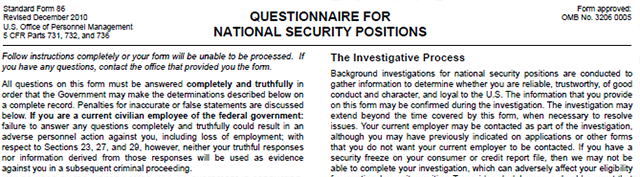
This does not mean that federal contractors get security clearances for free. They incur costs associated with the time required to process and maintain security clearances. The cost of these activities is largely unknown, but it can easily equal or exceed the average cost of an OPM investigation. Based on the number and type of each investigation, the weighted average cost is about $1230 per investigation. The total cost of a security clearance includes the investigation, adjudication, and front-end processing and maintenance costs. The cost of investigations is published by OPM. The cost of adjudication can be estimated based on the number and type of clearance requests and agency budgets. But no data are available on the cost of front-end clearance processing and clearance maintenance activities by federal contractors and would probably vary considerably from company to company.

Figure 1: FY2011 Prices of OPM Investigations4

INVESTIGATION PRIORITY HANDLING STANDARD SERVICE
NACLC --------- $228
SSBI $4,399 $4,005
SSBI-PR $2,964 $2,711
PPR $2,261 $2,009

The cost of clearance adjudication is paid for by government agencies. Adjudication times can range from 0 minutes to about 17 hours depending on the type of investigation and the complexity/seriousness of issues involved. The data shown in the chart (below) is based on all DoD clearance adjudications. Investigations for industrial clearances have a lower percentage of National Agency Checks with Law and Credit (NACLC) and a higher percentage of Single Scope Background Investigations (SSBI), SSBI Periodic Reinvestigations (SSBI-PR), and Phased Periodic Reinvestigations (PPR).

Figure 2: Adjudication Time/Cost by Investigation Type

INVESTIGATION AVERAGE TIME AVERAGE COST
NACLC (64%) 30 min. $75
SSBI (16%) 60 min. $150
SSBI-PR (6%) 120 min. $300
PPR (14%) 25 min. $62
All Investigations 40 min. $100

Some explanation of these figures is necessary. About 25% to 30% of DoD NACLCs are adjudicated by computer (eAdjudication) and require minimal human involvement. SSBIs generally contain more investigative reports than NACLCs and therefore take longer to review. All SSBI-PR contain some security or suitability issues and therefore take significantly longer to review than other investigations. All PPRs are clean cases. If an issue is developed on a PPR, the investigation is converted to an SSBI-PR.

As stated earlier, the cost of front-end clearance processing and clearance maintenance activities are largely unknown, and no reliable data are available to estimate the cost of these activities. But some generalizations are possible. OPM claims that completing the March 2010 version of the SF86 “is estimated to average 150 minutes per response, including time for reviewing instructions, searching existing data sources, gathering and maintaining the data needed, and completing and reviewing the collection of information.” This is probably accurate because the average is heavily weighted by military accessions, who tend to be young people with limited employment, residences, school, credit, etc. For the “average” contractor 240 to 300 minutes is probably a more reasonable estimate.

Facility Security Officers (FSO) will initially spend about 120 minutes per applicant in processing them in Joint Personnel Adjudication System (JPAS), reviewing their SF86, taking fingerprints, checking clearance status, and providing an initial security briefing. In the case of an existing employee, who requires a Top Secret clearance, additional time will be spent by the FSO, the applicant, his/her supervisor, and other employees for interviews with an investigator. These interviews will average from 15 minutes for other employees to about 60 minutes for the applicant. This also applies to employees who only require a Secret clearance, but whose personal histories contain significant security issues. Beyond this there are annual security briefings, travel briefings, visit requests, and debriefings.

Figure 3: Activities Resulting in Unknown Costs to Cleared Contractor Facilities

ACTIVITY FSO APPLICANT SUPERVISOR OTHER EMPLOYEES
JPAS Case Management X      
SF86 Preparation   X    
Fingerprinting X X    
SF86 Review X      
Checking Clearance Status X X    
Talking to Investigators X X X X
Lost Time Waiting   X    
Security Briefings X X    
Other File Maintenance X      
Adverse Actions* X X X  

* Adverse actions include Incident Reports, Written Interrogatories, Statement of Reasons, clearance suspensions, and clearance denials.

In the past, non-productive (or partially productive) time while waiting on a clearance was a major cost to employers. It’s still a major cost, but it has gone down considerably in the past 4 years as the average end-to-end processing time for most initial clearances has reportedly declined from 179 days to 65 days. Many employers have been able to avoid some of the direct costs of SF86 preparation and clearance delays by using Conditional Offers of Employment and not hiring job candidates until they receive either an interim or final clearance. But when an employee encounters a major problem with an initial clearance, clearance upgrade, or clearance renewal, it can cost an employer thousands of dollars in lost productivity. These problematic cases can involve upwards of one hour a week for the FSO, supervisor, and employee until the problem is resolved.


William H. Henderson is a retired federal clearance investigator, a personnel security consultant, and the author of Security Clearance Manual and Issue Mitigation Handbook. He is a regular contributor to ClearanceJobsBlog.com and ClearanceJobs.com.

Copyright © 2011 Last Post Publishing. All rights reserved.


Average (Not Rated)

0.0 stars
You must be logged in to recommend articles.
Comments
Can a federal contractor pay OPM to conduct a SSBI for another DoD agency? Also, can a contractor pay OPM to do an expedited SSBI?
Ed C. (Rockie Mountains) on February 22, 2012 at 4:22pm

good article
TCL (Washington, DC) on September 28, 2011 at 8:04pm

I had to do a chapter 7 after being unemployed with a child on the way. Though the judge said he understood but I still had mine suspended for a year. It then took almost 3 years to get the ball rolling in getting it reinstated, so I was terminated. I have many companies looking into me, because I am experienced in everything from armor, to weapon systems, to EW testing. Doesn't seem fair. I never was one to be a big spender or anything. Just nothing else I could do. I am a patriot to the core. I want to get back to what I know. I got the process going through my congressmans office, but it came to a halt once I was terminated.
K ( Arizona) on September 9, 2011 at 5:08am

M H (Charleston, SC),
I meant to say that a Secret clearance is good for 10 years from the date the appropriate investigation closed, not the adjudication date, and a TS is good for 5 years from the date the investigation closed.
Bill L. (Bowie, MD) on August 18, 2011 at 10:22am

M H (Charleston, SC),
You are correct except for one thing – a Secret clearance is good from the date the appropriate investigation closed, not the adjudication date, and a TS is good for 5 years from the date the investigation closed.
Bill L. (Bowie, MD) on August 16, 2011 at 9:27am

My clearance was pulled by the adjudication office. Then a company wanted me in their ranks because of my technical background and contacts. I told them my clearance had been pulled and is rarely reinstated once pulled. But the company persisted and had other work for me until the clearance was reinstated. After three years and not even my national background check had been returned for an interim clearance I wrote my senator and congressman. I was contacted in a week from one of their staff. Two weeks after that phone call my clearance was reinstated.
Lost&Found (BounchingAroundInternet) on August 12, 2011 at 8:06am

Just because you leave active duty does not mean you lose your clearance. The status changes from an 'active' clearance to a 'current' one. Depending on the type of clearance you had while serving and the date in which you were investigated determine whether your clearance has expired.

A SECRET clearance is good for 10 years from the issuing date while a TS is good for 5 years.

Once you receive a job that has a credible need for the clearance, it can become active again when you are read into that program.
M H (Charleston, SC) on August 11, 2011 at 9:55am

Jlook,

You do not loose your security clearance once you get out of the military. I retired in March 2011 and started working for my current company in April and my security clearance was still active.
Robert L Harris (McDonough Georgia) on August 11, 2011 at 4:20am

How long does it "usually" take for an investigator to contact an applicant about information on the SF86? I had a job but was dismissed because they had questions about issuing me a secret clearance.
Out Of Work insted of Deploying Overseas (Los Angeles) on August 10, 2011 at 9:26pm

Other posters comments are relavent. I would like this information and am willing to invenst to reactivate my clearance. Please address these issues
Owen L Angleton Jr. (Grovetown GA) on August 10, 2011 at 4:12am

I'm aware of at least 7 coworkers that entered the final adjudication phase of their TS/SCI FS Poly's 10 to 13 months ago. What is the real story behind final adjudication limbo. Please consider posting stats for different agencies if you can gain access to the data. It would be wonderful if someone could answer the following questions:
1. Does an adjudicator have a suspense per clearance?

2. Does the government have an audit mechanism in place to ensure work is being accomplished.

3. If not, how do you become an adjudicator? (I must be working in the wrong field)
Skeptical (VA) on August 10, 2011 at 2:03am

Jim N. (Charleston, SC):
I’ve written 2 articles on the subject of clearance reinstatement and reciprocal acceptance of existing clearances. One is posted on this website and is titled, “Security Clearance Reciprocity of Special Access Eligibility” (July 8, 2009). The other article is posted at my website (http://lastpostpublishing.com/SC_Articles.aspx) under the title, “Collateral Security Clearance Reinstatement & Reciprocity” (June 2008). The information in both articles is still fairly accurate. Some minor changes have occurred in the past 2 years. Two new 2 regulations have been added—ICPG 704.2 (para. C3) and ICPG 704.4.

Procedures for clearing someone with an expired clearance is the same as for someone who has never had a clearance. Reinstatements of DOD clearances are done using an RRU in JPAS.
William Henderson on August 10, 2011 at 12:35am

Thank you for the information on clearances
Ajmal Khoshbin (NY) on August 10, 2011 at 12:02am

Hey Angry. I know what you mean. It can take a while for adjudication but, it generally is worth the wait if you are going for a great position. I also lost several potential jobs waiting for mine. However, when the adjudication finally came through, I went to work exactly where i wanted, and it ended up being the most amazing opportunity I could imagine.

The bottom line, as long as you are working while waiting on adjudication of clearance for another job, what are you really loosing? You are only loosing a potential offer if the one you are clearing and adjudicating for is not that appealing. In that case, why apply for it in the first place?

Change your strategy, only apply for the cleared job that you really really want. Then the waiting and lost offers that are likely to occur, are worth it.
John Anon Ymous (nowhere) on August 9, 2011 at 6:53pm

To Angry Texas, Ask if you can resubmit your paperwork, they might have lost it, it usually takes only 3-6 months to get SCI if you already have a TS, sometimes they miss place paperwork. Hope that helps a little. TS clearances last 5 yrs, but have to be re-submitted within the last 6-8 months before it's due to run out, and and SCI clearance only lasts 2 yrs in most places. If your clearance runs out, or it has been a few yrs, try applying for jobs on USA jobs, even if it says a clearance is needed, they can't and won't hold it against you. Most DoD contractor firms won't even look at your resume with out a clearance, cause it will cost them money, and they are into making money, you probably already new that;-)
Dusty4x4 (Omaha, NE) on August 9, 2011 at 5:28pm

JLook,
If you had a TS when you were active duty, it became inactive when you checked out with your S-2 shop. Just the fact that you've been cleared (and are deemed eligible) for that clearance, is a big benefit to an employer.
Chris (jax,nc) on August 9, 2011 at 5:19pm

Very good article. This is information I'd always wondered about. Glad to have some details. Now, it be great if you could do another on the "lapsing" of clearances at different levels, time requirements, and reinstatement procedures companies must go through when trying to bring on an employee who previously held a clearance which went inactive. If you've already done this article, could you point me in the right direction. My searches haven't found it. Thanks again!
Jim N. (Charleston, SC) on August 9, 2011 at 12:56pm

If I had a top secret clearance while serving active duty and am now no longer cleared due to leaving service, how do I get a clearance so that I can apply for Security Clearance jobs?

Seems like a "cart before the horse" situation that only a select few people who leave the military at the exact right time can actually look for jobs that require clearance.
JLook (Central IL) on August 9, 2011 at 12:37pm

Funny here shows minutes in calculations for adjudications... Why does the poly added onto an active ts/sci take over a year to adjudicate then (clean sf86, no negative history what so ever!) yet one year and counting still no status update and lost job opportunity playing the waiting game!
Angry (Texas) on August 9, 2011 at 12:03pm

Bill H.,
Another excellent article. Great information. Keep up the good work.
Bill L. (Bowie, MD) on August 9, 2011 at 9:48am

Add Your Comments
Display Name:
Location:
E-Mail Address:
Comments:
 
Enter characters